I wrote my final paper on Miller’s “Autism” and Savarese’s “Toward a Postcolonial Neurology, and how the signs listed in those works could apply to Arthur Radley in “To Kill a Mockingbird”
I pledge
-Sonia B. Joshi
not just another wordpress site
I wrote my final paper on Miller’s “Autism” and Savarese’s “Toward a Postcolonial Neurology, and how the signs listed in those works could apply to Arthur Radley in “To Kill a Mockingbird”
I pledge
-Sonia B. Joshi
Throughout disability studies, the discussion is often centered around the “abled” or the “disabled,” but is this idea as black and white as it seems? When discussing Autism, in particular, the conversation of the “spectrum” comes into play, bringing along stereotypes of what it means to be autistic, what people with autism “should” look or “should” act like. Melanie Yergeau poses this discussion in “Introduction: Involution,” from Authoring Autism, asking if “there can ever really be an in-between” (Yergeau 2) or if it instead is an absolute dichotomy between those with autism and those without. It is here that I am arguing that autistic writers have set forth to define and demonstrate this dichotomy through their writings and creative discussion of how their autism, particularly their understanding of language and use of language, creates a divide between the two groups when it comes to everyday discussion, as well as the discussion around autism itself.
To begin, it’s important to understand Yergeau’s own discussion and proposition of dichotomy or no. Yergeau argues that “autism is typically characterized by what it contrasts” (Yergeau 2) presenting autism as an “antithesis” to the non-autistic, which she argues is demonstrated by the stories of those who raise autistic children and those who actually have autism as well. Yergeau’s primary examples include the discussion of “poop talk,” as discussed by parents of autistic children, “who have (presumably) never smeared their own [poop]” (Yergeau 3). Yergeau discusses these narratives as seen from the “other” perspective, and then recounts her own experience with remembering her own potty-training experience. She tells that time as more difficult than learning how to read discussing the “decoding of sensations, recognizing the tightness meant which function” (Yergeau 6) as things that have “long eluded” her. This distinct difference Yergeau discusses through “poop talk” is only the beginning of exploring the dichotomy recognized by autistic people between them and those without autism. While Yergeau is able to recognize the difficulties of her own potty-training and the ease that came with learning to read, those neurotypical parents focus more on the “anomaly” of how autistic children respond to feces, and the placement of autistic children as “victim-captives.” It’s through this small narrative the Yergeau presents the subtle beginning to the dichotomy defined by the autistic community itself. Even those who know the child the best, cannot fully understand them, or recognize their abilities in the way that the autistic person can, drawing a line between those with, and those without, autism.
Another autistic creator, DJ Savarese, expresses similar ideas as Mukhopadhyay in his poem “Alaska.” Savarese utilizes the image of winter in Alaska, to bring forth this same idea of separation and divide between Savarese and his non-autistic facilitators. For Savarese, this divide is separated by those who “yearn for freedom,” (people with autism) and those who “live forever” (the non-autistic). In examining other works, this “freedom” that Savarese discusses is brought to light to be communication and understanding. In his essay “Communicate With Me” Savarese expresses his desire for people to talk with him, and not his facilitator, whether it be by waiting patiently, or making direct eye contact to show that they care about what he has to say. In his own process of communicating, Savarese must “free [his] body to respond” (Savarese 5). This discussion of language being “Freedom” is what separates the “you” and the “they” in the poem. Whoever the poetic speaker is addressing is holding onto the leaves, symbolizing Savarese and his desire for the “freedom” of conversation that he seeks, and the stigma that his conversation must be guided by his able-bodied facilitators. Savarese directly speaks out against this in his essay, asking people to “look at and talk to him” (Savarese 7), instead of addressing his facilitator, as if they are the ones having conversation for him.
On the same topic of the differences between how those with and without autism can use and understand language, Amanda Baggs, another author with autism discusses what language presents itself as and how she can understand language differently than the non-autistic. In her commentary piece entitled “Up in the Clouds and Down in the Valley: My Richness and Yours,” Baggs discusses her relationship with language, recognizing that:
language was built mostly by non-autistic people, with the obvious results, and [her] biggest frustration is this: the most important things about the way [she] perceives and interact with the world around [her] can only be expressed in terms that describe them as the absence of something important. (Baggs 3)
This distinct lack that Baggs’ has to utilize language in the way that is seen as “normal,” along with her argument that “language was built by non-autistic people” demonstrates the difference between those with and without autism, and the consideration that would be needed to truly find a middle ground between the two groups, given their differences in social interactions.
Baggs later goes on to describe how using traditional language “takes place in the clouds” (Baggs 18), with its multiple layers and the need to balance physical language, expressive language, and figurative language. For people with autism, these concepts can be difficult to grasp alone- facial expressions and sarcasm can be daunting and decoding them isn’t a natural process. This line between what society has determined to be “language” has become a recognizable divide in the autistic community. Making “typical” societal discussion between the autistic and the non-autistic creates a divide between interactions of the two groups, without having to learn a new way of speaking.
In terms of disability, the conversation has always been led by the nondisabled. In the autistic community in particular, advocates and activists with this diagnosis have begun to speak about the current language barriers between those with and without autism, which creates a clear dichotomy between the two communities. This divide, however, could be closed and mended, if the non-autistic community could seek to listen, and truly seek to understand the autistic counterparts, instead of just assuming that their “language” is universal.
Word count 1008
I pledge that I neither gave nor received unauthorized help on this assignment.
When reading “Misfit,” I immediately recognized the disparity between the responses to someone with autism in humans versus nature. In the poem, the narrator says, “the birds knew I was Autistic; they found no wrong with anything,” followed by the contrast of the narrator saying, “men and women stared at my nodding; they labeled me as a misfit” (Mukhopadhyay). The idea that the birds see the narrator’s autism as no wrong, or nothing out of the ordinary symbolizes a sort of innocence from the ablest mindset of normalcy compared to disability. I perceive the birds as being innocent of societies wrongful influence on young people’s view of those with disabilities such as autism, compared to the men and women who have already been influenced by the harmful idea that able bodies are the only “normal” bodies. I relate this concept to Harper Lee’s To Kill a Mockingbird because of the way Scout perceives Tom Robinson. Although I am comparing Scout’s perception of race and the bird’s perception of disability, I believe both characters relay the same idea of innocence to societies false interpretations that some people are superior to others. For example, in To Kill a Mockingbird, Scout is often confused about why Tom Robinson’s race is the reason for the townspeople rooting against him and for his guilty sentence even though he was innocent. Since Scout grew up with Atticus teaching her to treat everyone as equals, from treating Walter Cunningham respectfully to defending Tom Robinson in court, she hasn’t been introduced to the racist ideologies within other people in Maycomb. Scout not knowing the ideas of racism resembles the birds in “Misfit,” since the birds don’t know that humans have set ideas of what is normal and what is seen as different or “misfit.” The views that Scout and the birds have on both Tom Robinson and the narrator with autism are refreshing since they don’t carry any negative and false societal impressions of racism or ableism.
“I hereby declare upon my word of honor that I have neither given nor received unauthorized help on this work.”
Keona May
My idea for this project was originally going to be in the form of a paper. My original plan was to write a paper about how the adult characters in Harper Lee’s “To Kill a Mockingbird” could have and should have intervened with the children’s treatment of Arthur Radley and taught them sooner that just because someone is different does not innately make them dangerous.
For instance, in the beginning of the novel when Dill was asking for a description of Arthur, Jem gave a detailed, exaggerated and embellished statement and said, “Boo was about six-and-a-half feet tall, judging from his tracks; he dined on raw squirrels and any cats he could catch, that’s why his hands were bloodstained” (Lee 47). Then he said, “there was a long jagged scar that ran across his face; what teeth he had were yellow and rotten; his eyes popped, and he drooled most of the time” which made Dill respond with, “Let’s try to make him come out” so they could “see what he looks like” (Lee 48). This initial association with Arthur, who they also never referred to by his actual name and solely called him Boo, with monster-like qualities caused them to torment Arthur with games about him, and they invested many hours into devising schemes to get him to come outside only to fuel their own imaginative curiosities about what he looked like. In other words, instead of taking the time to get to know Arthur or considering that the reason he remained inside is because of something he cannot control or perhaps a disability, they immediately villainized him and dehumanized him completely by making him this character who they must see simply because he is different from them. Of course this judgment can be understandable since they are children and have not had much exposure to the world yet, in addition to the time period the book takes place, racism is still rampant, and hence it is a societal norm to judge others different than them whether that be based on race, overall appearance or financial status, etc. However, adult characters like Atticus and Miss Maudie, who although made some effort to correct the children, should have made it a priority to specifically teach them that the reason Arthur chose not to leave his home is most likely not complicated or with mal-intent. Oftentimes adults try and shield children away from people who are different or who have disabilities and instead of answering questions they have, they dismiss the conversation and say phrases like “don’t stare just keep walking” which further perpetuates the stigma that people with disabilities are different in a bad way as well as the “us vs. them” superiority mindset.
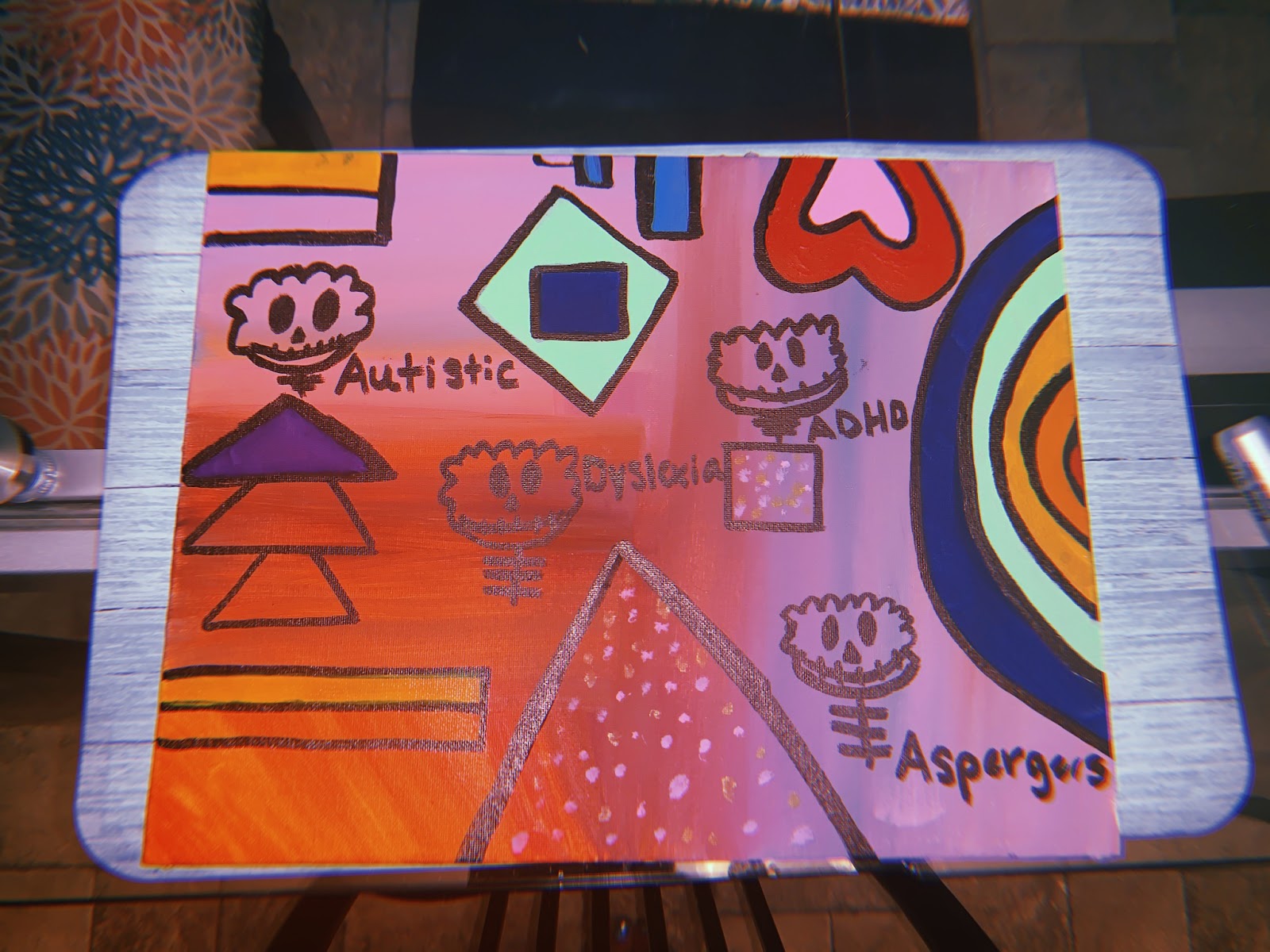
With all of this in mind, I produced a new idea for my project that I believed could be better told in the form of a painting instead of through a paper which I feared would become redundant. Consequently, my new idea was to create an abstract painting with an alluring background filled with vibrant colors as the focus of the piece and then I wanted to draw small, also abstract-looking, skeletons with different disability labels on them i.e. dyslexia, ADHD, autistic, and aspergers. The purpose of my painting and inclusion of the skeletons is to convey the message that although humans appear to be different on the outside, at our core we are all the same and are all capable of beauty. Additionally, the reason I made the painting abstract is to convey that no one person gets to define what beauty means, but it is more important than labels which is why I spent the majority of my focus on blending colors and adding eye catching, brilliantly colorful shapes. I honestly had no specific plan as to how I was going to create the abstractness look other than I picked the brightest/most aesthetically pleasing colors I had in my possession and just let my brush flow with no true rhyme or reason other than creating something that was soothing to look at. I am very pleased with the final result and I believe it conveys both my original vision and my message- that we are all capable of beauty and labels are insignificant, perfectly.
Lee, Harper. To Kill a Mockingbird. New York :Harper Perennial Modern Classics, 2006.
I thoroughly enjoyed this poem because I feel like in a way it acts as a kind of “full circle” moment for our class. The poem itself is assigned reading on the last day of our class meeting and it touches on the topics we talked about and discussed all the way back in week one. The poem itself obviously touches on how our society makes individuals with a disability feel isolated or like the “other” and it also touches on labels associated with disabilities. (another thing we talked about in the first few weeks of class) The poem itself not only talks about these topics and provides commentary on them eloquently, but it’s also acting as a test for oursleves and our class as a whole. When we first started taking part in this course, we (or at least I) knew very little about disabilities and the way our society responds to and reacts to them but now we (again maybe it’s just myself) are fully able to pick apart and understand what the author is talking about. We are able to show how we ourselves have grown and gained knowledge on the subject and that’s a beautiful thing.
It has been great getting the chance to share my thoughts with you all while we’ve been in this class together. I’ve not only received a lot of helpful feedback on my posts, but you all made great posts on here as well and it’s been really fun getting the chance to hear your thoughts on the readings we’ve done. I hope you all have a great break and here’s hoping we’ll get another class together.
Until next time 🙂
Hypoesthesia: A Close-Reading Analysis of Love in Disability
Enjoy!
Have a good night everyone!
Eliana: This book is very diverse in it’s content, like the intentional misgendering of charcters.
Maddie: Yeah, this book and the rest of what we’ve discussed has talked a lot about the intersectionality of disability and it’s relation to sex, gender, and race.
Daniel: The author very intentionally includes discussions on class and other intersectionality, not necessary a full on allegory, but definitely an intentional discussion
Emily (we couldn’t quite understand due to wifi, but was attempting to contribute to the discussion of authors intention.)
Dr. Foss asks us about Aster and leaves
Maddie: Aster is an active demonstration of the societal expectations that her disability prevents her from fulfilling. Theo originally calls her his intellectual superior, in a way of support?, but doesn’t realize the full capability that Aster has
Sonia: People in the book expect Aster and Theo to be romantically involved, but they feel more than friendships, but not whole-heartedly romantic. Theo expects here to define those goals and she just cant.
Maddie: Did you guys think anything about the POV changes, did it work as well in Good Kings Bad Kings?
Sonia: I think it was more distracting, especially since it was in third-person limited 90% of the time. The switching provided different perspectives but the lack of consistency took away from the story.
Eliana: I can see the pros and cons of different povs, but this novel had a lot of characters that all had agency, and the limited pov took away from the agency that they could have had. In terms of disability, the pov can help show how disability plays into the novel
Maddie: The limited third person perspective provides the readers with a thought of what Aster herself is limited to.
Foss: What about the setting?
Daniel: The setting allows us to have some type of reflection on our society. The fact that the futuristic setting, leaving Earth, could demonstrate that we had to leave because we destroyed the Earth. The demonstration of race with Theo shows that not much changed from the past to the future.
Maddie: The movement of humanity to space, but the repetition of the same events could be a representation of that cliche of “repeating the same things over and over again is insanity” which could relate to Dickinson’s piece on Madness. he societal acceptance of their mass madness, but the rejection of what they view as “mad” because it’s different, despite being supposedly “Advanced”
